After Collapse at a Basketball Game, 7th-Grader Saved by Heart Transplant
Pediatric Transplant Week highlights the importance of organ donation for children like 12-year-old Chino, who can look forward to a healthy life, thanks to a new heart.
7:00 AM
Author |
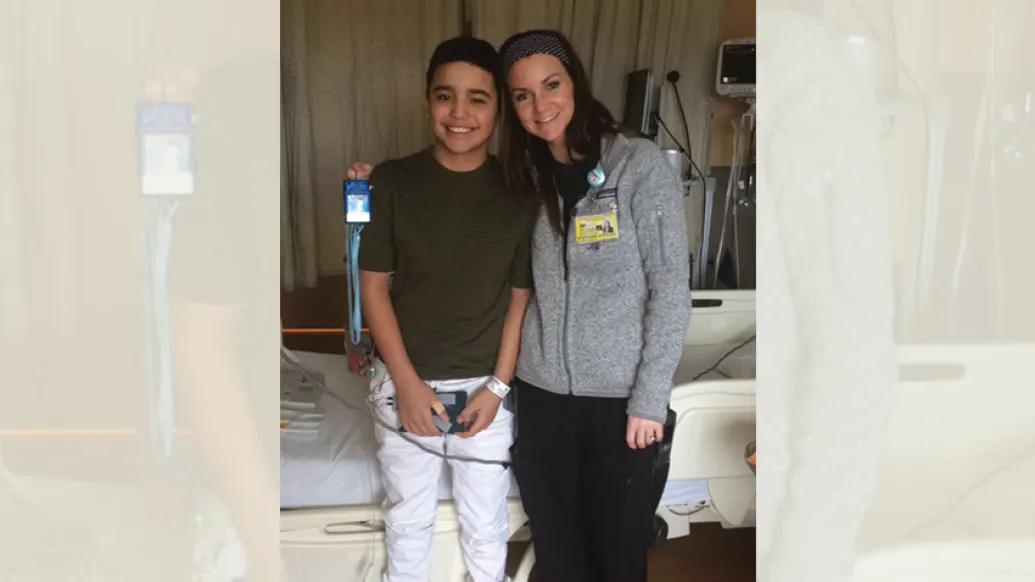
For 12 years after open-heart surgery for a congenital heart condition, Homar "Chino" Hernandez lived an active, healthy life.
MORE FROM MICHIGAN: Sign up for our weekly newsletter
But that changed last November when the seventh-grader was doing what he loved most: playing basketball. During his team's first game of the season, he was elbowed in the chest by another player and struggled to breathe. Feeling like he was having an asthma attack, he asked his coach for a break after halftime.
When his mother noticed he hadn't returned from the locker room, she went to check on him and found her son unconscious on the floor. He had suffered cardiac arrest and lung failure.
After being stabilized at a hospital near the family's home in Kalamazoo, the middle schooler was transferred to University of Michigan C.S. Mott Children's Hospital, where doctors discovered he had a severely narrowed coronary artery. Surgeons repaired the artery. Initially he recovered well but developed progressive heart failure as a result of the initial arrest.
The only cure was a new heart.
"That news just took my breath away. I can't describe the feeling of hearing that your baby needs a new heart. But we knew we had to stay positive," his mother Valerie Silva says. "We just prayed."
In January, Chino was placed on the transplant waiting list. Three months later, on Good Friday, his family learned he had a new heart.
"This gift means everything to us," Silva says.
Giving life
Chino is among more than 50 children who received organ transplants in Michigan between 2017 and 2018. Nationally, there are more than 1,260 children currently on an organ waiting list, according to the Organ Procurement and Transplantation Network.
SEE ALSO: Tiny Heart Repaired While Baby Still in the Womb
Chino's complications were rare, doctors say, and it's unclear exactly what caused his arrest. Some underlying heart damage is not easily detectable.
It's the second greatest scare his heart has caused his family.
At birth, Chino suddenly turned purple, unable to breathe. Silva remembers holding him for only a few minutes before he was transported by helicopter from Kalamazoo to Ann Arbor.
At Mott, he was diagnosed with a congenital heart condition known as Transposition of the Great Arteries. The condition means that the arteries are in the wrong position and reversed from their normal connections, preventing the body from receiving the proper amount of oxygen.
He immediately underwent heart surgery to repair the arteries.
"Since then, he's had no health problems, and we were thankful he could do all of the things he wanted to do, like play basketball. He loves basketball," his mother says.
As a result of receiving his new heart, doctors say he will be able to play again next year.
Heading home
Chino was discharged from the hospital recently. He will spend the next couple of months at home with his four younger siblings and new puppy, an American Bully named Hercules. During the summer, his family also plans to visit relatives in Texas and see the stadium where one of his favorite teams, the Dallas Cowboys, plays.
"He's so strong and so positive," Silva says. "He's the one who kept me strong through all of this. I'd be sitting here crying my eyes out, and he'd come hug me with a big beautiful smile and say, 'Don't worry, Mom, everything is going to be OK.' He's a fighter."
"To me it's a second chance at life. We are grateful and want to share his story with the world so people can see how big of a difference (organ donation) makes."

Health Lab
Explore thousands of health news & research stories by visiting the Health Lab homepage for more.
Media Contact

Public Relations
Department of Communication at Michigan Medicine
Stay Informed
Want top health & research news weekly? Sign up for Health Lab’s newsletters today!
Featured News & Stories

4 ways to teach your teen safe driving habits
U-M-led consortium to receive up to $52 million in NIH funding to study why viral respiratory infections affect children differently

4 in 5 parents say having a baby is too expensive

Digital alerts support timely treatment decisions of critically ill cardiac patients

Is the United States Lagging Behind Europe in Memory Improvement?